

 English
 عربى

From Engineering Mechanics to Thermal Design: Deconstructing the Underlying Technical Logic of High-End Outward-Opening Window Systems
Sep 24, 2026
Content
In building envelope systems, outward-opening casement windows are highly favored because they do not occupy interior space and provide a large ventilation area.
However, due to their exposed load-bearing hardware structure and the need to withstand complex weather conditions, the system design of outward-opening casement windows has long been considered a technical challenge in door and window engineering.
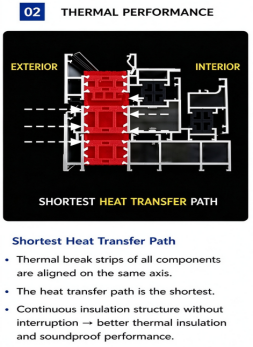
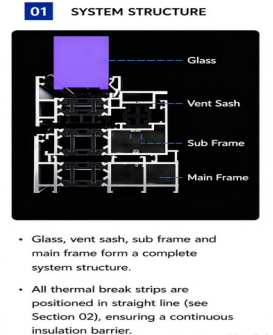
Traditional doors and windows often focus solely on the wall thickness of the profiles, while neglecting the system's overall integrity. In Section 01 of the first diagram, we can clearly see the system's hierarchical structure: Glass → Vent Sash → Sub Frame → Main Frame.
Key Technical Points:
Thermal Break Alignment: The system requires that the thermal break strips of all components be aligned in a straight line (the area highlighted in red in Section 02). This is referred to as the "shortest heat transfer path."
Continuous Thermal Barrier: Only when the thermal break strips of the glass, sash, sub-frame, and main frame are perfectly aligned can a continuous thermal barrier without any breaks be formed. This not only maximizes the blocking of heat transfer (High Thermal Insulation) but also effectively enhances sound insulation (Excellent Soundproofing).
Industry Insight: Many doors and windows suffer from drafts and water leakage, which are essentially caused by misaligned thermal break strips leading to the "thermal bridge effect," resulting in condensation and energy loss. DCMC's design philosophy demonstrates that the core of system windows and doors lies in "system synergy," rather than the mere assembly of individual components.
Drainage Design: The Balance Between Front Drainage and Hardware Protection
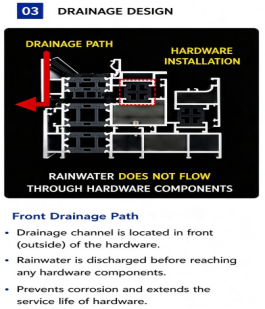
The biggest challenge with outward-opening windows is that the hardware is susceptible to corrosion from rainwater. Section 03 illustrates DCMC's front drainage path.
Technical Logic:
Front-Mounted Drainage Channel: The drainage channel is designed at the front (outdoor side) of the hardware installation chamber.
Physical Isolation: Rainwater is drained outdoors through the drainage holes before it enters the hardware components.
Result: This design ensures that "rainwater does not flow through the hardware components." This significantly reduces the risk of hardware corrosion and jamming, fundamentally extending the service life of the hardware system (Long Service Life).
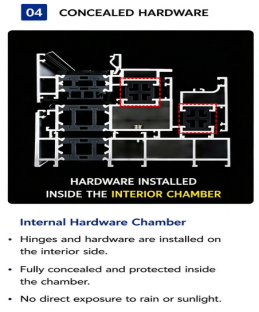
Industry Insight: While concealed hardware is aesthetically pleasing, improper drainage design can easily lead to internal water accumulation. Front-mounted drainage, combined with an internal sealed chamber (Section 04), is the optimal solution to resolving the conflict between "aesthetics and durability."
Structural Mechanics: Force Equilibrium and Wind Pressure Resistance Design for Concealed Hardware
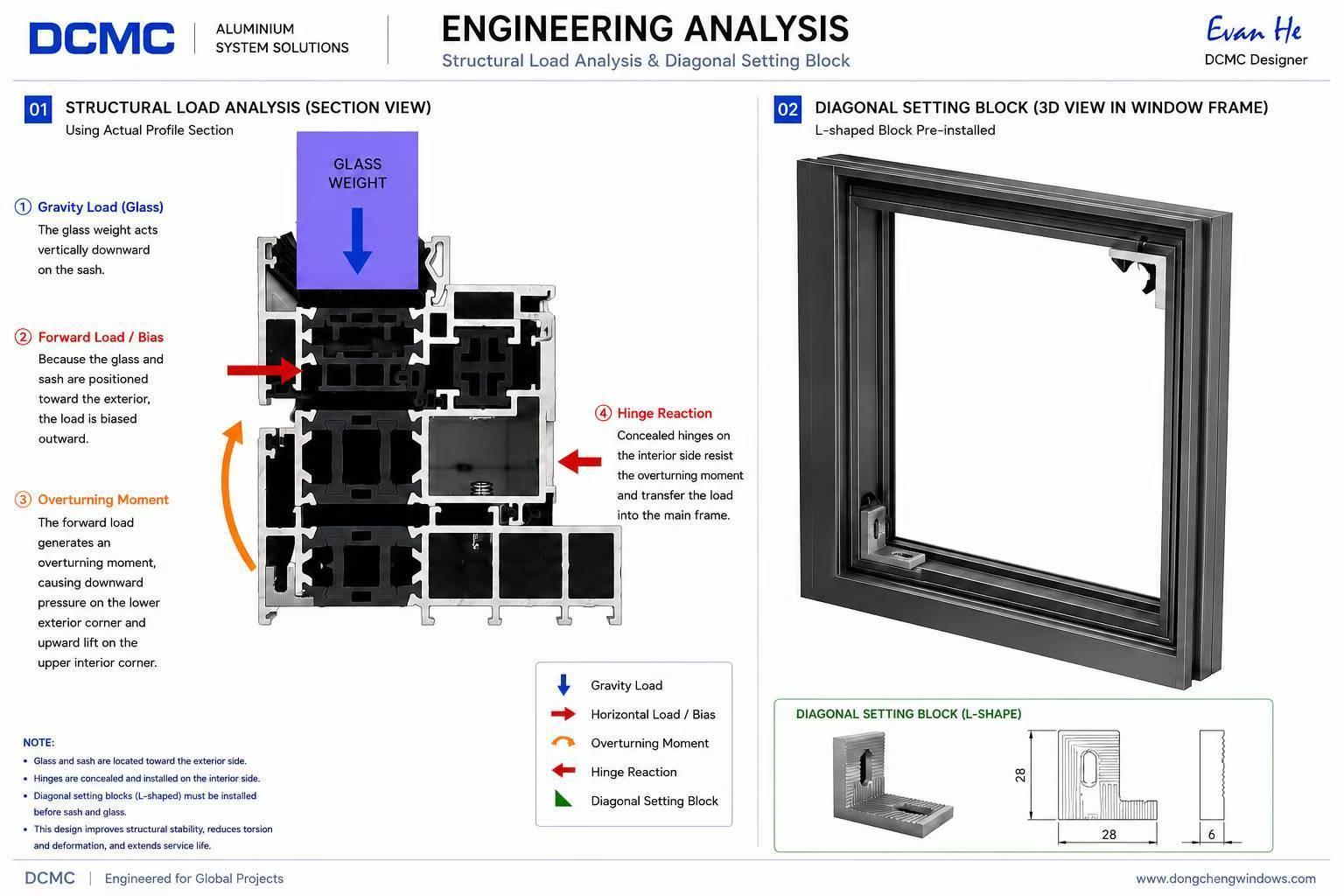
The second diagram (Structural Load Analysis) reveals the most critical structural challenge of concealed-hardware outward-opening windows. Because the center of gravity of the glass and sash is shifted toward the exterior, the system faces a complex structural environment.
Four Major Load Analyses (Section 01):
- Gravity Load: The weight of the glass acts vertically downward on the sash.
- Forward Load / Bias: Because the glass and sash are biased toward the exterior, the load generates an outward bias force.
- Overturning Moment: The forward load generates an overturning moment, causing compression at the lower outer corner and tension at the upper inner corner.
- Hinge Reaction: The hinges, concealed on the interior side, must provide sufficient reaction force to resist the overturning moment and transfer the load back to the main frame.
Key Technical Solution: Diagonal Setting Block
To address the complex mechanical challenges described above, the figure specifically highlights the pre-installation of L-shaped diagonal setting blocks (Section 02).
Function: These L-shaped setting blocks are installed at the corners of the window frame to ensure precise alignment before corner assembly.
Structural Benefits: They enhance the structural stability of the window frame corners, reducing torsion and deformation caused by overturning moments, thereby ensuring that the sash does not sag or jam during long-term opening and closing.
Industry Insight: Concealed hardware demands extremely high installation precision. The L-shaped positioning block is not merely an installation accessory but also a structural reinforcement component. It addresses the structural risks posed by the "top-heavy" design of outward-opening windows and is an unsung hero in enhancing the system's stability.
Conclusion: The "Engineering Mindset" Behind High-End System Doors and Windows
From these two engineering analysis diagrams, we can see that behind every high-performance outward-opening window lies a rigorous engineering approach:
- Thermally, the goal is to achieve perfect alignment of isotherms to create a continuous thermal barrier.
- For drainage, a front-drain design is used to separate water and electricity, thereby protecting the hardware.
- Structurally, mechanical analysis is used to optimize the load distribution on the hinges, and L-shaped positioning blocks are employed to reinforce corner strength.
- Regarding hardware, all components are fully concealed within the interior cavity to protect them from sun and rain.
For real estate developers and architects, selecting a door and window system should not focus solely on profile brands and wall thickness; greater attention should be paid to whether the joint design features a complete closed-loop system of mechanical and thermal performance. DCMC's analysis report undoubtedly provides the industry with an excellent engineering model.
Technology creates value; details determine longevity. As the door and window industry evolves toward high performance and extended service life, this foundational design logic—rooted in engineering analysis—is the true core competitive advantage.



- Mobile
- Products
- Aluminum Window Series
- Aluminum Door Series
- Aluminum Sunroom Series
- Aluminum Sunroof Series
- Aluminum Louver Series
- Aluminum Railing Series
- Aluminum curtain wall
- Aluminum panel
- Aluminum door, window and curtain wall auxiliary materials
- Contact Us
-
-
+86-137 5720 8001

-
[email protected]

-
Room 102, Building 7, No. 399 Shushan Road, Hudong Street, Wuxing District, Huzhou City, Zhejiang Province, China

-


