

 English
 عربى

EN AW 5086 AlMg4 Aluminium Alloy: Properties and Building Applications
Oct 27, 2026
Content
Alloy selection rarely makes headlines, yet it quietly decides how a facade behaves after ten years of salt spray, thermal cycling and wind-driven rain. EN AW 5086 — better known in mill catalogues as AlMg4 — earns its place not by being the strongest or the cheapest option, but by being remarkably dependable in wet, coastal and structural situations. At Dongcheng we manufacture aluminium windows, doors, curtain walls, sunrooms, louvres and railings, and we meet 5086 most often on the plate-and-sheet side of a project: panels, flashings, brackets and marine-adjacent details. This guide gathers what we have learned from specifying, welding and finishing it, so you can judge quickly whether it suits your next building.
What EN AW 5086 Actually Is
The designation EN AW 5086 comes from the European standard system for wrought aluminium. The letters AW stand for wrought aluminium, and the four-digit number places the alloy inside the 5000 series, where magnesium is the principal alloying element. Its older and still widely used name is AlMg4, which hints at the magnesium content: roughly 3.5 to 4.5 percent.
The remaining chemistry is modest but important. Manganese sits between 0.2 and 0.7 percent, chromium between 0.05 and 0.25 percent, while iron, silicon, copper, zinc and titanium are kept low as impurities. That lean recipe gives the alloy a single, very useful personality: it cannot be strengthened by heat treatment at all. Any extra strength comes from cold working, which is why temper designations matter far more than a simple chemical certificate.
Practically speaking, 5086 arrives at the fabricator as sheet, plate, coil or tread plate. It is not a typical extrusion alloy, which is the first thing to understand when comparing it with the 6063 sections used for window frames and mullions.
Properties That Matter on Site
Several characteristics make this alloy a frequent choice for demanding environments:
- Seawater corrosion resistance. Magnesium plus a small chromium addition supports a stable surface film, so the alloy performs well in marine atmospheres, splash zones and industrial air.
- Weldability. It welds cleanly by MIG and TIG with matched filler, retaining good joint efficiency, which suits fabricated panels and built-up frames.
- Low-temperature toughness. Ductility holds up well in cold conditions, useful for cold stores, northern facades and transport applications.
- Formability. It bends, rolls and presses readily in the annealed condition, so curved fascia and shaped flashing are realistic.
- Finishing. Anodising and powder coating both bond well to a properly pretreated surface.
- Moderate strength. Work-hardened tempers reach useful structural values, but it is not a substitute for a high-strength heat-treated alloy where peak load capacity governs.
Tempers and Typical Mechanical Values
Temper choice changes the alloy more than most buyers expect. Annealed material is soft and highly formable; strain-hardened tempers trade ductility for strength. H116 is a stabilised condition developed specifically for marine service, where resistance to intergranular attack matters as much as tensile figures.
| Temper | Typical tensile strength (MPa) | Typical yield strength (MPa) | Elongation | Where we use it |
|---|---|---|---|---|
| O / H111 | 150–240 | about 100 | High | Formed flashings, curved trims |
| H112 | 240–250 | 105–125 | Moderate | General plate work, brackets |
| H116 | 275 and above | about 195 | Moderate | Coastal panels, splash-exposed parts |
| H32 / H22 | 275–335 | about 185 | Moderate | Fascia, louvre blades, cassettes |
| H34 / H24 | 300–360 | about 220 | Lower | Higher-load panel and trim |
How 5086 Compares with Nearby Alloys
Buyers often ask why one project uses 5086 and another 5083, and why window frames are almost always 6063. The short answer is that each alloy is optimised for a different manufacturing route and a different failure mode.
| Alloy | Approx. magnesium content | Strength character | Seawater corrosion | Typical building use |
|---|---|---|---|---|
| EN AW 5086 | 3.5–4.5% | Medium, work hardened | Very good | Panels, plate details, coastal work |
| EN AW 5083 | 4.0–4.9% | Medium to high | Very good | Heavier marine and structural plate |
| 6061 T6 | about 1.0% | High, heat treated | Good | Machined brackets, hardware |
| 6063 T5 / T6 | about 0.5% | Low to medium | Good with coating | Extruded window and curtain wall profiles |
In other words, 5086 and 6063 are colleagues rather than rivals. A typical unitised facade may use extruded 6063 profiles for the frame grid and 5086 sheet for spandrel panels, cornices or folded trims. What matters is that the two are detailed so they do not fight each other through differential movement or galvanic contact.
Where EN AW 5086 Fits in a Building Envelope
Because the alloy is supplied flat, its natural home is in the parts of a facade that start life as a sheet. We see it most in solid aluminium panel cladding, where a work-hardened temper gives the cassettes enough stiffness to stay flat across a bay while the magnesium content keeps edges and folds resistant in humid or coastal air.
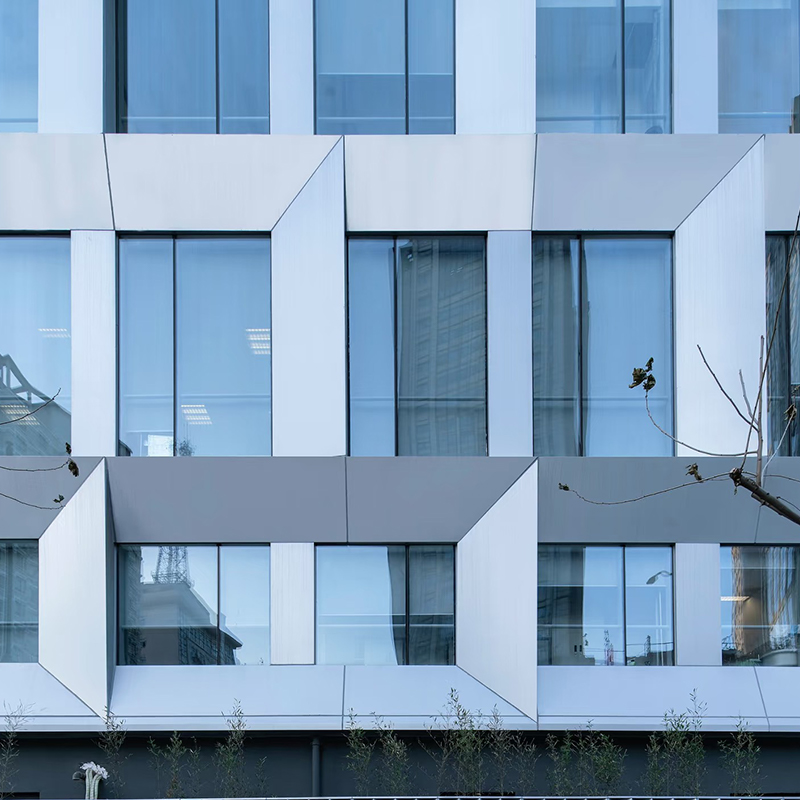 Single-Layer Aluminum Panel Curtain Wall SystemA lightweight single-skin aluminium facade for commercial and institutional buildings, with coated weather-resistant panels and off-site fabrication for efficient installation.View Product →
Beyond panels, it appears in flashings and cill trims where bending radius matters, in louvre frames and blades for plant screens that face driving rain, and in secondary structural brackets that sit close to the weather. Sunroom details near the coast also benefit, since the same material can be folded, welded and coated without changing supplier. Our own teams have seen this at first hand on overseas work, including project sites in the Philippines, where salt-laden air and typhoon winds make alloy and fixing choices very concrete decisions.
 Custom Aluminum Single Panels for Facades and InteriorsPrecision-fabricated aluminium panels with coating and texture options for facade cladding, ceilings, canopies and shopfronts, available in standard or bespoke sizes.View Product →
For ventilated plant areas and car park screens, a rain-resistant louvre built around a corrosion-tolerant frame is often the simplest way to combine airflow with weather protection.
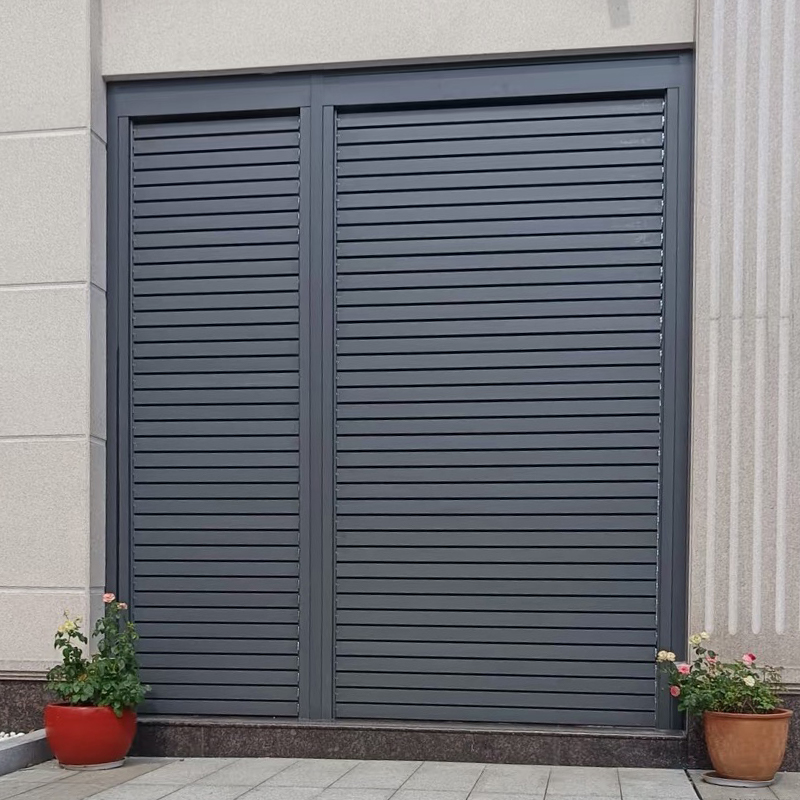 Rain-Resistant Aluminum Louver for Ventilated OpeningsFixed-blade aluminium louver with drip edges and internal baffles to balance natural ventilation with rain exclusion in plant rooms and facade openings.View Product →
Where the alloy is less suitable is in slender, highly sculpted profile work. Extrusion is simply the better process there, and 6xxx alloys deliver the surface quality and dimensional consistency that visible frames require.
Fabrication and Finishing Notes
Welding 5086 is straightforward with the right consumable, but heat input still needs control to avoid softening a strain-hardened zone. We usually design joints so that welded areas sit away from the most highly stressed fibre, and we specify the post-weld condition explicitly rather than leaving it to the workshop.
Two other habits save trouble later. First, separate aluminium from steel and stainless components with isolating washers, gaskets or a coated interface, because a coastal atmosphere plus a dissimilar metal is a reliable recipe for galvanic attack. Second, remember that anodised or powder-coated 5086 will not always match an adjacent 6063 extrusion exactly, even with the same nominal finish, because the alloys respond slightly differently to pretreatment. Approving a physical sample of both, side by side, avoids a very awkward conversation on site.
Quick specification checklist
- State the temper, not just the alloy, and reference the product standard.
- Confirm whether the part is welded and, if so, the required post-weld condition.
- Define the finish system and its warranty exposure, especially within one kilometre of the coast.
- Detail isolation between dissimilar metals at every fixing point.
- Agree flatness tolerances for visible panel work before fabrication begins.
A Practical Way to Decide
If your project involves sheet-based cladding, folded trims, splash-exposed details or a coastal location, EN AW 5086 deserves a serious look. If it involves long, visible extruded profiles, machined brackets or a need for maximum strength in a thin section, another alloy will usually serve you better. Most successful envelopes end up using both, each where it belongs.
That is how we approach every enquiry: understand the exposure, the geometry and the finish expectation first, then choose the material route that keeps the building watertight and predictable for decades. Better systems for better buildings start with that kind of quiet, unglamorous decision about alloy and temper.

- Mobile
- Products
- Aluminum Window Series
- Aluminum Door Series
- Aluminum Sunroom Series
- Aluminum Sunroof Series
- Aluminum Louver Series
- Aluminum Railing Series
- Aluminum curtain wall
- Aluminum panel
- Aluminum door, window and curtain wall auxiliary materials
- Contact Us
-
-
+86-137 5720 8001

-
[email protected]

-
Room 102, Building 7, No. 399 Shushan Road, Hudong Street, Wuxing District, Huzhou City, Zhejiang Province, China

-


