

 English
 عربى

Aluminum Alloy Composition Explained: Elements, Series, and Real-World Uses
Oct 13, 2026
Content
- 1 What Aluminum Alloy Composition Actually Tells You
- 2 The Elements That Matter Most
- 3 Reading a Four-Digit Alloy Number
- 4 Composition Across the Eight Series
- 5 Wrought or Cast: Two Very Different Recipes
- 6 Why the 6000 Series Dominates Windows and Doors
- 7 From Profiles to Facades: Composition in Curtain Walls
- 8 Sheet, Panel and Cladding Alloys
- 9 A Short Checklist for Reviewing an Alloy Specification
Aluminum alloy composition is one of those subjects that looks tidy on paper and gets interesting the moment you sit down with a real specification. Pure aluminum is light, conducts heat well and resists corrosion, but it is far too soft to carry a window frame on the twentieth floor of an office tower. Add controlled amounts of magnesium, silicon or zinc, and the same metal can take structural loads, hold a powder-coated finish through years of sun and rain, and still weigh roughly a third of what steel would.
That is why alloy chemistry is never just an academic footnote. It decides whether a profile can be extruded at all, how it behaves during welding and anodizing, and how it will look after a decade of weather. For anyone working with windows, doors, sunrooms or curtain walls, understanding composition is the fastest route to knowing what a product can honestly do.
What Aluminum Alloy Composition Actually Tells You
In its simplest form, aluminum alloy composition is a list of elements and the percentage range each one is allowed to occupy in the finished metal. Aluminum itself usually makes up 90 to 99 percent of the alloy by weight. The remaining fraction — silicon, iron, copper, manganese, magnesium, chromium, zinc, titanium and a few others — shapes almost everything about how the material performs.
Two details are easy to miss. First, those numbers are ranges rather than fixed values, because every heat of metal varies slightly; standards such as ASTM B221, EN 573-3 and GB/T 3190 set acceptable limits instead of exact recipes. Second, composition alone does not decide performance. The temper — the heat treatment and mechanical working that follows — turns the same chemistry into very different products.
The Elements That Matter Most
Nine elements do most of the work in commercial aluminum alloys. Each has a distinct job, and most are helpful in small doses and troublesome in large ones.
- Silicon: lowers melting point and improves casting fluidity; with magnesium it forms the Mg2Si particles that make 6000-series alloys heat-treatable.
- Magnesium: the main strengthening addition in 5000 and 6000 series and a strong contributor to corrosion resistance.
- Copper: raises strength and hardness considerably, especially in 2000 and 7000 series, at the cost of corrosion resistance and weldability.
- Manganese: controls grain structure and lifts strength in 3000-series alloys without harming corrosion performance.
- Zinc: with magnesium, produces the highest-strength commercial alloys in the 7000 series.
- Iron: normally an impurity; small amounts refine grain in castings, while excess reduces ductility and finish quality.
- Chromium: improves resistance to stress corrosion cracking in 6000 and 7000 series.
- Titanium: a grain refiner used in tiny amounts to keep cast structure uniform.
- Trace additions: boron, beryllium, lithium and others appear in specialized alloys, often in fractions of a percent.
Reading a Four-Digit Alloy Number
Most people meet alloy composition through a four-digit number. In the wrought designation system the first digit identifies the alloying family, the second marks a modification of the original alloy, and the last two simply distinguish one registered composition from another. A temper designation such as T5, T6 or H14 is added after a hyphen, so 6063-T5 and 6063-T6 share chemistry but differ in strength and hardness.
Cast alloys follow a different convention: three digits plus a decimal, as in 356.0 or A360.0, with a letter prefix marking national variations. Mixing the two systems up is a common slip in early project discussions, and it usually resurfaces later as a supplier asking for clarification.
Composition Across the Eight Series
The Aluminum Association groups wrought alloys into eight series, and the grouping is really a quick summary of composition. The table below is a working overview, not a replacement for a material certificate.
| Series | Defining elements | Common grades | Typical use in buildings |
|---|---|---|---|
| 1000 | 99% aluminum or more | 1050, 1100 | Foil, trim strips, decorative sheet |
| 2000 | Copper | 2014, 2024 | Aerospace parts; rarely used in exposed facades |
| 3000 | Manganese | 3003, 3105 | Composite panel skins, roofing, gutters, signage |
| 4000 | Silicon | 4043, 4045 | Welding filler wire, brazing sheet |
| 5000 | Magnesium | 5005, 5052, 5083 | Cladding, louver blades, coastal-grade panels |
| 6000 | Magnesium and silicon | 6060, 6061, 6063, 6005A | Window and door profiles, curtain wall mullions |
| 7000 | Zinc, with magnesium and copper | 7050, 7075 | High-load structural parts, aerospace fittings |
| 8000 | Other elements, including lithium and iron | 8006, 8011; cast 356.0 | Specialized sheet, foil, cast hardware |
The pattern to remember is that higher numbers do not mean better alloys, only different alloying strategies. A 3003 sheet and a 6063 extrusion are both excellent at their jobs; they simply solve different problems.
Wrought or Cast: Two Very Different Recipes
Before comparing percentages it helps to know which family you are looking at. Wrought alloys are cast into ingots and then rolled, extruded or forged into shape, so their chemistry is tuned for formability: low iron, controlled silicon, and just enough alloying element to respond to heat treatment without cracking.
Cast alloys are poured directly into a mould and keep the shape in which they solidify. Silicon levels can reach 12 percent to keep the metal fluid, and small additions of copper or magnesium raise strength in items such as brackets, corner cleats, hinge bodies and hardware. The two families rarely substitute for one another, which is why a casting specification and a profile specification can look surprisingly different even when both are described simply as aluminum alloy.
Why the 6000 Series Dominates Windows and Doors
Walk through our workshops and the material you are most likely to pick up is a 6000-series profile. 6063 is the workhorse: roughly 0.45 to 0.9 percent magnesium, 0.2 to 0.6 percent silicon, iron capped near 0.35 percent, with magnesium and silicon balanced so the alloy responds predictably to T5 or T6 tempering. It extrudes into complex shapes with thin walls and clean surfaces, and it takes anodizing and powder coating evenly.
When loads grow — long mullions, heavy door stiles, structural glazing — 6061 and 6005A come into play. Both carry more magnesium and silicon, and 6061 also contains copper, which lifts strength at a small cost to corrosion resistance and weldability. Choosing between them is a genuine engineering decision rather than a price decision, and it is one we work through with project teams all the time.
 Custom Aluminum Sliding Window with Dual- or Triple-Rail TrackA customizable aluminum sliding window for residential and light commercial glazing, using stainless-steel rollers, EPDM seals, and reinforced profiles for smooth, watertight operation.View Product →
From Profiles to Facades: Composition in Curtain Walls
Curtain wall design stretches the same chemistry in two directions at once. Mullions and transoms need stiffness, so designers move toward 6061 or 6005A in heavier wall sections, while visible caps and covers may stay with 6063 for its finish quality. Large unitized panels also demand consistent extrusion tolerances, because small differences in chemistry show up later as differences in how a profile behaves during machining and assembly.
Where a project faces high wind or seismic requirements, composition is only the starting point. Reinforcement, connection detailing and tested assembly performance usually decide the outcome far more than a few hundredths of a percent of magnesium. Still, an alloy specified correctly from the beginning saves a great deal of rework on site.
 Stick-Built Aluminum Curtain Wall System for Low- and Mid-Rise ProjectsOn-site assembled mullion-and-transom curtain wall with thermally broken profiles, pressure plates, and cover caps for flexible low- and mid-rise commercial facades.View Product →
Sheet, Panel and Cladding Alloys
Not every aluminum surface in a building begins as an extrusion. Composite panel skins, louver blades, rainwater goods and decorative cladding are usually rolled from 3000- or 5000-series sheet. 3003 is the familiar manganese alloy: moderate strength, easy to form, widely painted. 5005 and 5052 add magnesium, which noticeably improves strength and corrosion resistance; 5052 is the classic choice for coastal and marine-adjacent work.
Because these alloys harden as they are rolled, their properties depend on temper designations such as H14 or H24 as much as on chemistry. A panel specified only by alloy number, with no temper, quietly leaves performance on the table.
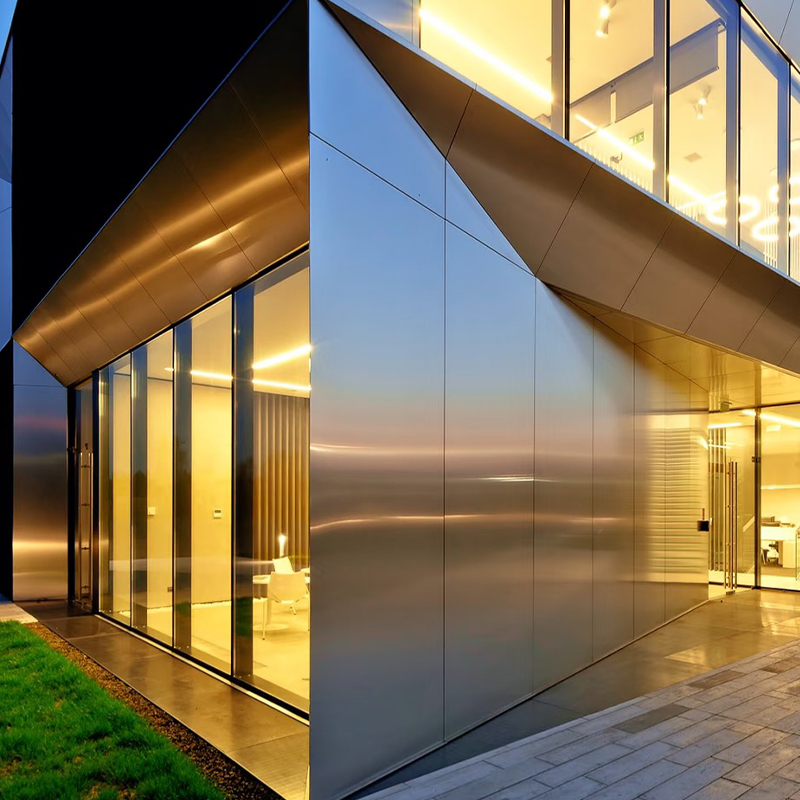 Composite Aluminum Panel Curtain Wall with Mineral-Core Fire-Resistant OptionsA lightweight, flat sandwich-panel facade system for high-rise projects, with mineral-core fire options and high-performance fluorocarbon finishes.View Product →
A Short Checklist for Reviewing an Alloy Specification
When a drawing lands on your desk, a few quick checks will catch most of the confusion before it reaches the factory floor.
- Confirm the series and grade, and make sure the supplier is quoting the same designation you are.
- Check the temper alongside the alloy; the two are always specified together.
- Ask which standard governs the composition limits — ASTM, EN, GB or another — and whether certificates will be provided.
- Match the alloy to the environment, since coastal air, industrial pollution and de-icing salts all change the answer.
- Verify finish compatibility, because anodizing and coating respond differently to silicon, iron and copper content.
Aluminum alloy composition rewards a little curiosity. Once you can read a designation and connect it to the elements behind it, a specification stops looking like an arbitrary string of numbers and starts reading like a series of decisions, each one made for a reason. That is the approach we take in our own production, where profiles are selected, tested and controlled under a standardized ISO9000 quality system so that what arrives on site matches what was designed.
If you would like to see how those choices play out in practice, our guide to aluminum sliding window benefits, costs and installation walks through the details, and our team is always glad to talk through a specific project.



- Mobile
- Products
- Aluminum Window Series
- Aluminum Door Series
- Aluminum Sunroom Series
- Aluminum Sunroof Series
- Aluminum Louver Series
- Aluminum Railing Series
- Aluminum curtain wall
- Aluminum panel
- Aluminum door, window and curtain wall auxiliary materials
- Contact Us
-
-
+86-137 5720 8001

-
[email protected]

-
Room 102, Building 7, No. 399 Shushan Road, Hudong Street, Wuxing District, Huzhou City, Zhejiang Province, China

-


