

 English
 عربى

Aluminum Surface Finishes: A Practical Guide for Windows and Curtain Walls
Oct 09, 2026
Content
Aluminum does not rust the way steel does, but that does not mean it can be left bare. The surface finish is what decides whether a window frame still looks sharp after fifteen summers of sun and rain, or turns chalky and patchy long before its hardware wears out. We build aluminum windows, doors, curtain walls, sunrooms, railings, and louvers at our factory in Huzhou, Zhejiang, and one thing has held true across every project we have shipped: the finish is not decoration. It is the part of the system that lives outdoors. This guide walks through the aluminum surface finishes we work with most often, how they behave once they are on a building, and how to choose one that fits your project.
What an Aluminum Surface Finish Actually Does
Left alone, aluminum forms a thin natural oxide layer within minutes of meeting air. That layer is remarkably stable, which is why aluminum does not flake away the way untreated steel does. It is also only a few nanometres thick, so it rubs off under a fingernail and offers almost nothing against salt spray, acid rain, or the ultraviolet light that slowly breaks down organic materials.
A proper finish builds a much thicker, engineered layer on top, and it earns its keep in four ways:
- Corrosion protection, especially against chloride in coastal air and de-icing salt along roads.
- Colour and gloss stability, so a facade finished years ago still matches one finished today.
- Abrasion and chemical resistance, so frames survive site handling, construction dust, and years of cleaning.
- Appearance, which is usually the reason the finish was specified in the first place.
In architectural work, coating performance is usually described with the AAMA 2603, 2604, and 2605 specifications. They are a handy shorthand: 2603 suits interior and light-duty exterior use, 2604 covers most residential and commercial exteriors, and 2605 is the grade expected on high-rise curtain wall, where colour retention over decades matters most. When a supplier quotes a finish, the standard behind it tells you more than the colour name does.
The Aluminum Surface Finishes You Will Meet Most Often
Mill Finish
Mill finish is exactly what leaves the extrusion press: bare aluminum with visible die lines, a soft sheen, and no added protection. It is inexpensive and perfectly adequate for concealed frames, internal stiffeners, and parts that will be coated later. On a visible exterior facade it is a poor choice, because handling marks, water stains, and uneven oxidation appear quickly. When a quotation says natural aluminum, ask whether that means true mill finish or clear anodizing, which is a very different product.
Mechanical Finishes: Brushing, Polishing, and Blasting
Mechanical finishes reshape the metal instead of coating it. Brushing leaves a directional satin grain, polishing brings the surface close to a mirror, and bead blasting produces a uniform matte texture. They are common on handrails, window railings, decorative panels, and interior trim, and often serve as the base layer under anodizing. Outdoors they need a top coat, because bare mechanical surfaces collect fingerprints, water spots, and fine scratches.
Anodizing
Anodizing is an electrochemical process that grows the natural oxide layer into a dense film that is part of the metal, typically 10 to 25 micrometres thick on architectural parts. Because it does not sit on the surface, it cannot chip or peel, and it handles salt air and abrasion very well. The trade-off is colour: anodized tones stay within the silver, champagne, bronze, and black family, and matching an exact tone across separate production batches takes discipline. It remains a favourite for coastal facades, hardware, and railing systems.
Powder Coating
Powder coating sprays an electrostatically charged resin onto the aluminum and cures it in an oven, leaving a tough film of roughly 60 to 100 micrometres. It offers the widest colour range of any finish, holds up well to sunlight, and resists chipping better than most liquid paints. Most of our residential window and door systems, including outward opening casement and top-hung windows, are finished this way, and the same system covers louver blades and balcony railings where one colour has to hold across many different profiles.
 Custom Aluminum Outward-Opening Casement and Top-Hung WindowsCustom outward-opening aluminum windows with casement or top-hung sashes, powder-coated for residential systems, offering ventilation and space-saving operation.View Product →
PVDF and Other Liquid Coatings
PVDF finishes are liquid-applied fluoropolymer coatings, usually 20 to 30 micrometres thick and almost always specified to AAMA 2605. They are the standard for curtain wall and high-rise cladding because fluoropolymer resin shrugs off ultraviolet light far better than polyester, holding colour and gloss for decades. They cost more and need longer curing, which is why they rarely appear on small residential jobs. Other liquid paints such as polyester and polyurethane fill the gap below PVDF when a particular colour is needed at a moderate price.
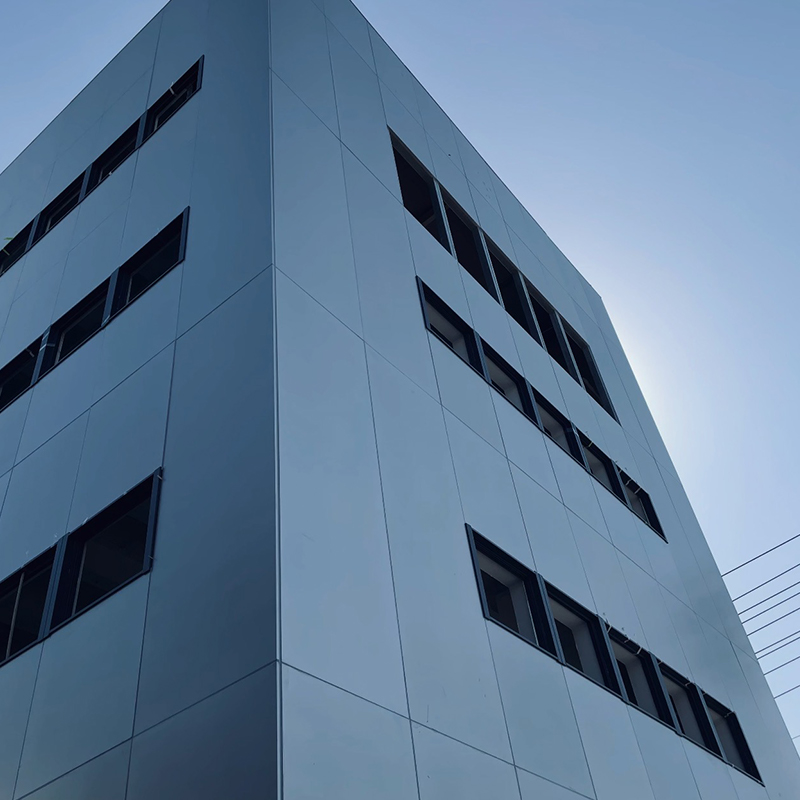 Unitized Aluminum Curtain Wall for High-Rise FacadesFactory-assembled floor-height facade units with interlocking joints and drainage, suited to high-rise projects where PVDF finishes are commonly specified.View Product →
Wood Grain Sublimation
Sublimation transfers a printed film onto a powder-coated profile under heat, so the grain sinks into the coating instead of sitting on top of it as a printed pattern. From a few metres away the result reads convincingly as timber, without the repainting, rot, or splintering. It is popular on windows, doors, sunrooms, and garage frames. The pattern stops at cut edges and joints, so those details deserve extra care on site, and as with any organic coating, quality depends on the pretreatment underneath.
Comparing the Common Finishes at a Glance
| Finish | Typical film thickness | Where it works best | Weathering and UV | Relative cost |
|---|---|---|---|---|
| Mill finish | None (natural oxide only) | Hidden frames, interior structure | Poor outdoors | Lowest |
| Mechanical (brush, polish, blast) | Not a coating | Railings, trim, decorative panels | Needs a top coat outdoors | Low |
| Anodizing | 10 to 25 micrometres | Coastal facades, hardware, railings | Very good | Moderate |
| Powder coating | 60 to 100 micrometres | Windows, doors, louvers, railings | Good to very good | Moderate |
| PVDF liquid coating | 20 to 30 micrometres | Curtain wall, high-rise cladding | Excellent | Highest |
| Wood grain sublimation | 60 to 100 micrometres over a powder base | Windows, doors, sunrooms | Good, with care at edges | Moderate to high |
Choosing a Finish for Windows, Doors, and Curtain Walls
Finish selection is rarely about picking the most expensive option. It is about matching the coating to the environment, and to the way the part will be seen and touched over its lifetime.
- Location and air quality. A building a few hundred metres from the sea, or beside a heavy traffic route, needs anodizing or a 2605-grade coating far more than one in a sheltered inland town.
- Orientation and exposure. Horizontal surfaces such as sunroom roofs, skylight frames, and sills weather much harder than vertical walls, because rain, dust, and ultraviolet light all linger there longer.
- Consistency across the package. Windows, doors, louvers, railings, and curtain wall panels should be specified as one finish system. Two slightly different bronze tones on a finished elevation are impossible to miss.
- Maintenance expectations. Powder-coated and PVDF surfaces clean easily with mild肥皂 and water, while anodized surfaces are even simpler but show fingerprints on dark tones.
- Budget and lead time. PVDF carries the highest unit cost and the longest lead time; powder coating delivers most of the performance at a fraction of the cost for low- and mid-rise work.
It also helps to think about the opening type at the same time, because hardware tolerances, drainage, and cleaning access change with the system. A finish that suits a fixed curtain wall panel may not suit a moving sash. Our notes on aluminum sliding windows look at those practical details in more depth.
Where Aluminum Finishes Usually Go Wrong
When a finish fails, the cause is almost never the aluminum itself. It is the process behind the coating, and the problem usually shows up within the first two years, which is why the pretreatment line deserves more attention than the colour sample.
- Weak pretreatment. If a profile is not properly degreased, etched, and rinsed, the coating still looks fine in the factory and then blisters or peels after a season of rain.
- Under-cured powder. A short or cool cure leaves a film that scratches easily and chalks early. Cure is measured, not guessed.
- Thickness outside the range. Too thin and the film cannot hide extrusion lines or resist UV; too thick and it turns brittle and chips at the corners.
- Batch-to-batch colour drift. Small differences are invisible on a single window and obvious across a facade of two hundred panels.
- Unprotected cut edges and joints. Cut ends, drill holes, and site cuts are the first places corrosion starts on any coated profile.
Our own line runs under the ISO 9000 quality system, with monitored pretreatment baths, coating thickness gauges, gloss and colour checks against approved master panels, cross-hatch adhesion tests, and salt spray sampling. None of that is glamorous, but it is the reason a finish schedule can be repeated on a second phase of the same project years later.
Keeping a Whole Building Consistent
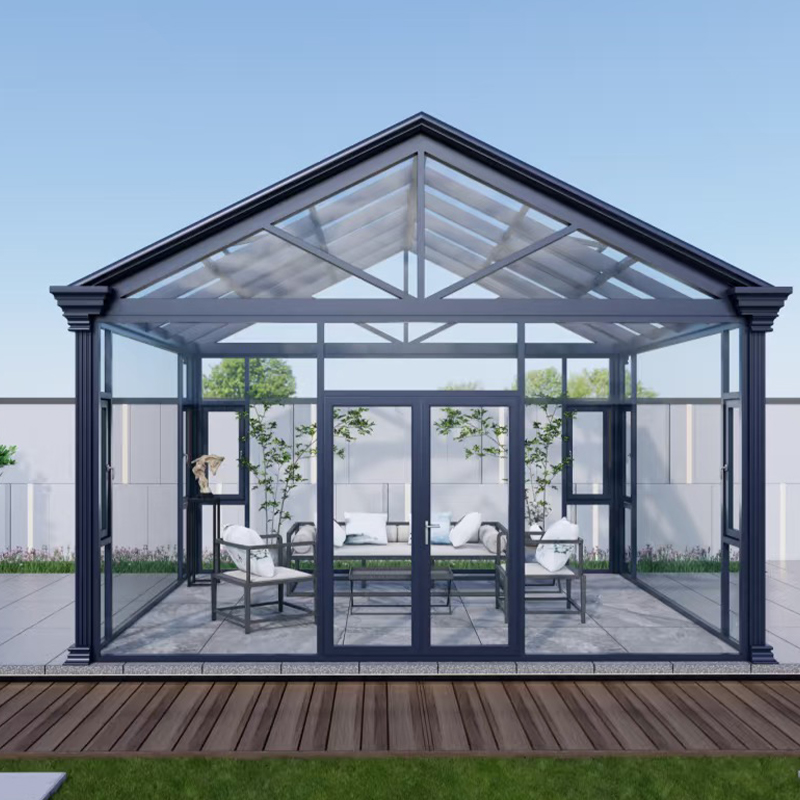
Colour consistency is a scheduling problem as much as a chemistry problem. On large projects we suggest coating the entire window, door, sunroom, and railing package within one production window, against one approved master panel, and keeping spare coated sections on site for touch-up. On a recent arched roof sunroom, the difference between a good result and a great one came down to keeping the roof profiles and the wall profiles in the same coating batch, so the whole structure aged at the same rate in the same weather.
 Arched Roof Aluminum Sunroom with Weather-Resistant SurfaceAluminum arched-roof sunroom with continuous curved roof, weather-resistant coating, tempered glass, and options for roller blinds and ventilation.View Product →
Aluminum surface finishes are one of those details nobody notices when they are done well, and everybody notices when they are not. Choose for the environment first, the colour second, and keep the whole package on one system. If you are planning a facade, a sunroom, or a full window and door package, our team is glad to talk through the finish schedule with you, because the questions are usually the same ones we ask ourselves before a batch goes into the oven.
For readers who want to go one level deeper on the hardware side, our notes on aluminum electric lift windows cover their features, costs, and benefits in more detail.


- Mobile
- Products
- Aluminum Window Series
- Aluminum Door Series
- Aluminum Sunroom Series
- Aluminum Sunroof Series
- Aluminum Louver Series
- Aluminum Railing Series
- Aluminum curtain wall
- Aluminum panel
- Aluminum door, window and curtain wall auxiliary materials
- Contact Us
-
-
+86-137 5720 8001

-
[email protected]

-
Room 102, Building 7, No. 399 Shushan Road, Hudong Street, Wuxing District, Huzhou City, Zhejiang Province, China

-


